
Adaptive
Re-use
Project Name
House on the Lake
Sector
Cultural Centre
Location
Ramat Gan National Park, Israel
Year
2026
Project Status
Re:Form Design Competition
Issuing Organisation
Buildner
A cultural island reborn.
The House on the Lake is envisioned as a cultural island, where nature, architecture and community converge in the heart of Ramat Gan’s
National Park.
Floating gently above the water, the project reimagines the former Beit Ha’am pavilion as a landmark of renewal, offering both intimacy and spectacle. Its design aims to transform the lake into a living stage, where hospitality and performance overlap, where construction becomes an art form, and where the act of gathering is elevated into a poetic civic experience.


Continuity through memory
and form
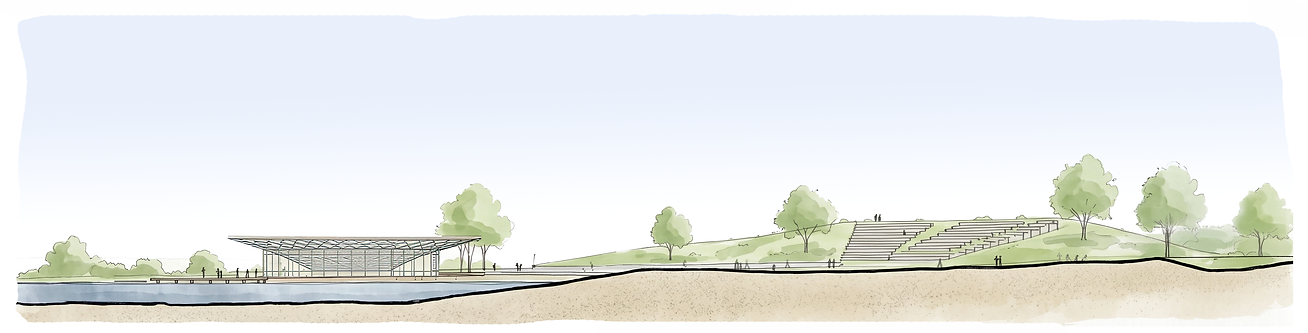
Although the original pavilion is structurally unsalvageable, its cultural DNA continues to shape the project. A new amphitheatre and restaurant reinterpret Beit Ha’am’s civic role, positioned in direct spatial dialogue with the existing lakeside amphitheatre. Together, they form a continuous public landscape, linking past and present across the water.
The circular logic of the former hall is retained in memory and proportion, yet reworked into a more open and inhabitable form. Through concrete terraces, framed openings, and visual connections between the two amphitheatres, the project honours collective memory while providing a renewed setting for everyday social and cultural life.
Parametric logic uniting form
and function
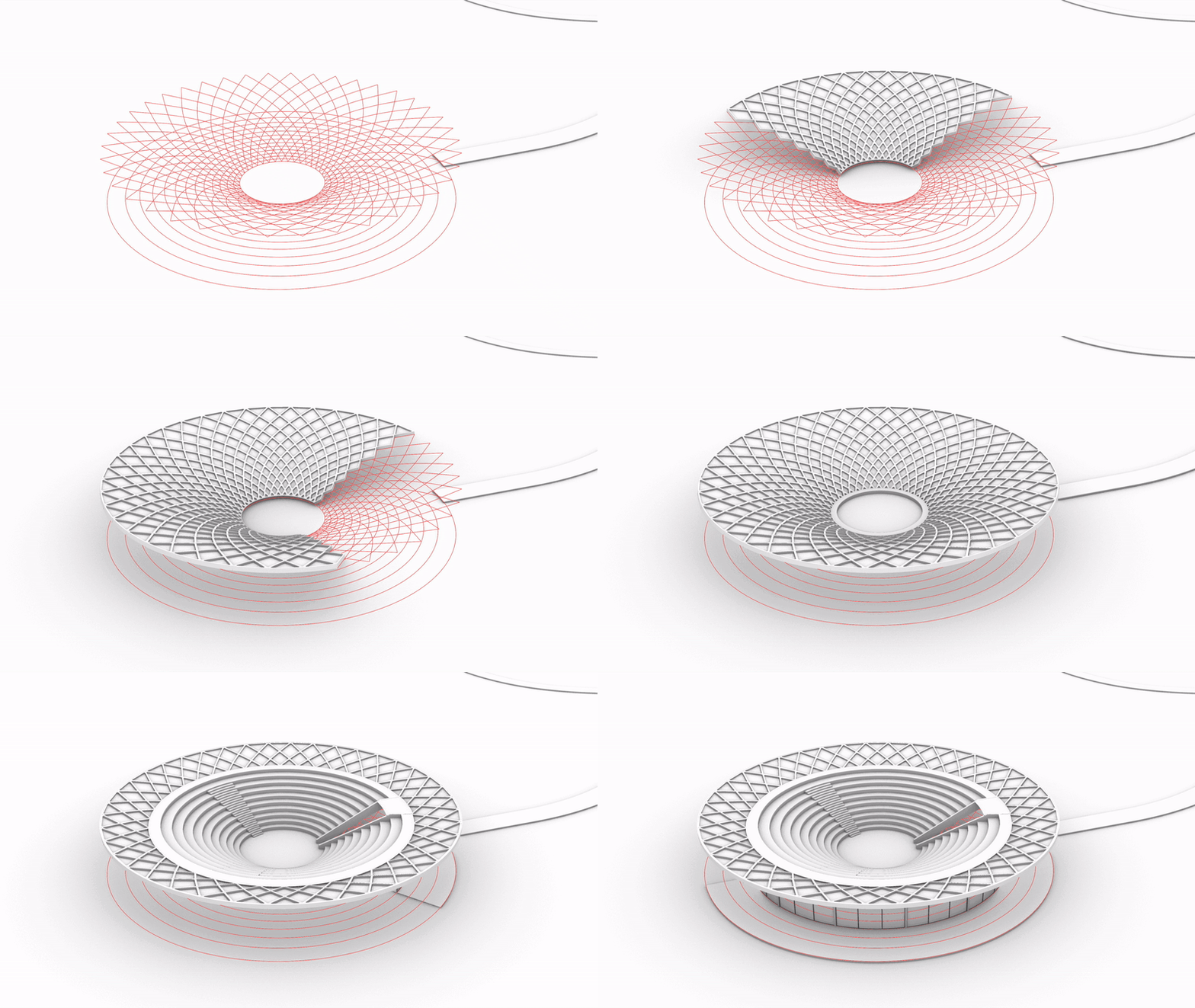
The project’s evolution is guided by a parametric workflow, enabling control of geometry, proportion, and construction logic. Through computational modeling, the amphitheatre steps and Nervi-inspired lattice are rationalized into efficient, buildable systems. This workflow transforms design into a living system, where parameters such as sightlines, spans, and thicknesses can be tested and refined. The process unifies technical logic with aesthetic clarity, ensuring every element contributes equally to performance and beauty.
The House on the Lake thus emerges as a contemporary fusion of culture, craft, and computation.

The portal dissolves the boundary between performance and landscape
At the heart of the amphitheatre, a precisely cut opening frames the lake beyond, transforming the water into an active participant in the civic space. This portal dissolves the boundary between performance and landscape, allowing sound, movement, and reflection to extend outward across the water.
Rather than enclosing activity, the amphitheatre opens itself to its surroundings. The stepped concrete seating descends gently toward the lake, creating a calm, human-scale setting where everyday use and small-scale cultural events unfold in direct dialogue with the landscape. The lake becomes both backdrop and foreground, a continuous presence that anchors the space in memory, place, and collective experience.
The restaurant is organised as a circular public room, wrapped around the amphitheatre and opening continuously toward the lake.
The plan establishes a clear spatial hierarchy: a central stage and performance space anchors the composition, while dining, bar, and outdoor seating areas radiate outward, maintaining constant visual and physical connection to water and landscape.
Movement through the pavilion is intuitive and fluid. Visitors arrive via the footbridge and are gently drawn along the curved perimeter, where indoor and outdoor spaces merge. Service functions are embedded discreetly within the ring, allowing the public areas to remain open, flexible, and uninterrupted. The result is a pavilion that supports everyday use while remaining adaptable to cultural events, performances, and collective gathering.


Portal to the Lake, Portal to the Sky
Sculpted openings explore the pavilion as a spatial threshold rather than a closed object. One opening extends horizontally toward the water, establishing a direct relationship with the lake, while the other turns upward to frame light, air, and sky. Together, they demonstrate how geometry and openness mediate between landscape and atmosphere, creating moments of pause, orientation, and quiet contemplation.
Concrete lattice as poetic construction
Inspired by Luigi Nervi’s mastery of expressive engineering, the amphitheatre roof becomes both landscape and poetic construction, uniting performance space above with sculptural order below.
A lattice of concrete ribs supports terraced seating for hundreds while simultaneously forming a vaulted ceiling that defines the restaurant interior. This duality enriches both experiences: civic performance above, intimate gathering below. Reflected across the still surface of the lake, the lattice doubles its presence, merging with sky and water, amplifying architecture’s dialogue with nature, and reinforcing the timeless elegance of concrete.

